
Mason County Parole Versus Probation
Michigan parole is conditional release from state prison. The Michigan Parole Board decides whether an eligible prisoner may leave secure custody, and MDOC Field Operations Administration supervises the person after release. A parolee remains in MDOC legal custody until discharge. Probation is a court sentence served in the community under stated conditions. A probationer may have served time in Mason County Jail, but may also have received probation without a state-prison term.
The source of authority is the key difference. A parole record follows an MDOC prison sentence and a Board decision. A probation record follows a sentencing order. Ordinary pretrial bond is neither parole nor probation, even though the person is out of the Mason County Jail and must obey bond conditions.
| Point | Parole | Probation |
|---|---|---|
| How it begins | Release from an MDOC prison after a Parole Board grant | A sentence imposed by a court |
| Prior prison term | Yes, for the parole case | Not required |
| Public first check | OTIS “Parolees” status and field-office location | OTIS for MDOC felony probation, plus the sentencing court record |
| How it ends | MDOC discharge from parole supervision | Discharge under the controlling probation order |
- Parole
- Conditional community release from prison while MDOC jurisdiction continues.
- Probation
- A community sentence imposed by a court and enforced through stated terms.
- Discharge
- The formal end of the supervision term, not merely release from a cell.
- Absconder
- A supervision status alleging that the person is unavailable to the supervising agency.
Check Mason County Supervision Status
The official first check for an MDOC parolee or felony probationer is the Michigan Offender Tracking Information System. OTIS covers people now under MDOC supervision and qualifying people discharged within the prior three years. It does not cover a jail-only sentence, an ordinary county misdemeanor case, or a person more than three years past MDOC discharge. A failed OTIS search therefore does not prove that no Mason County probation record exists.
Use an MDOC number when known. Name search can return more than one person. The live form also supports sex, race, age, marks, scars, tattoos, and status choices such as parolees, probationers, discharged people, parole absconders, and probation absconders. Compare the profile’s identifiers, convictions, status, and location before relying on it.
- Open OTIS and search by MDOC number, or enter the full name and useful identity fields.
- Select “Parolees” or “Probationers” when checking active Mason County supervision. Use “Discharged” to test whether MDOC jurisdiction recently ended.
- Open the matching profile. Read status and supervision location together, not in isolation.
- If Mason County or its Ludington office is listed, contact that office for an exact current reporting question.
- For a local court sentence that OTIS does not cover, check the 79th District or 51st Circuit register of actions through MiCOURT.
For the complete custody and court-record path, use the Mason County released inmate search and distinguish a county-jail release from an MDOC discharge.
Note: OTIS is a public status source, while the controlling court order and MDOC file supply the formal legal record.
Mason County Parole Office Details
Research Section 19’s local supervision angle is unusually concrete. The current MDOC Region 4 directory places Mason County in Region 4 and lists a parole and probation office in Ludington. The county probation page says the office is in a Sheriff Department annex. This local route matters after OTIS identifies Mason County as the supervision location because a generic Lansing contact cannot confirm the same field-office facts.
Mason County Parole/Probation Office
408 Resseguie Street, Suite 101
Ludington, MI 49431-2574
231-845-1266
Monday through Friday, 8 a.m. to 5 p.m.
The official Region 4 office directory is the best source to recheck the listing before a visit. A caller should have the person’s name and MDOC number, if known, and should ask a focused supervision question. Staff may limit information where law or safety rules apply.
The directory page is shown in this successful subject-matched capture from the official MDOC source.
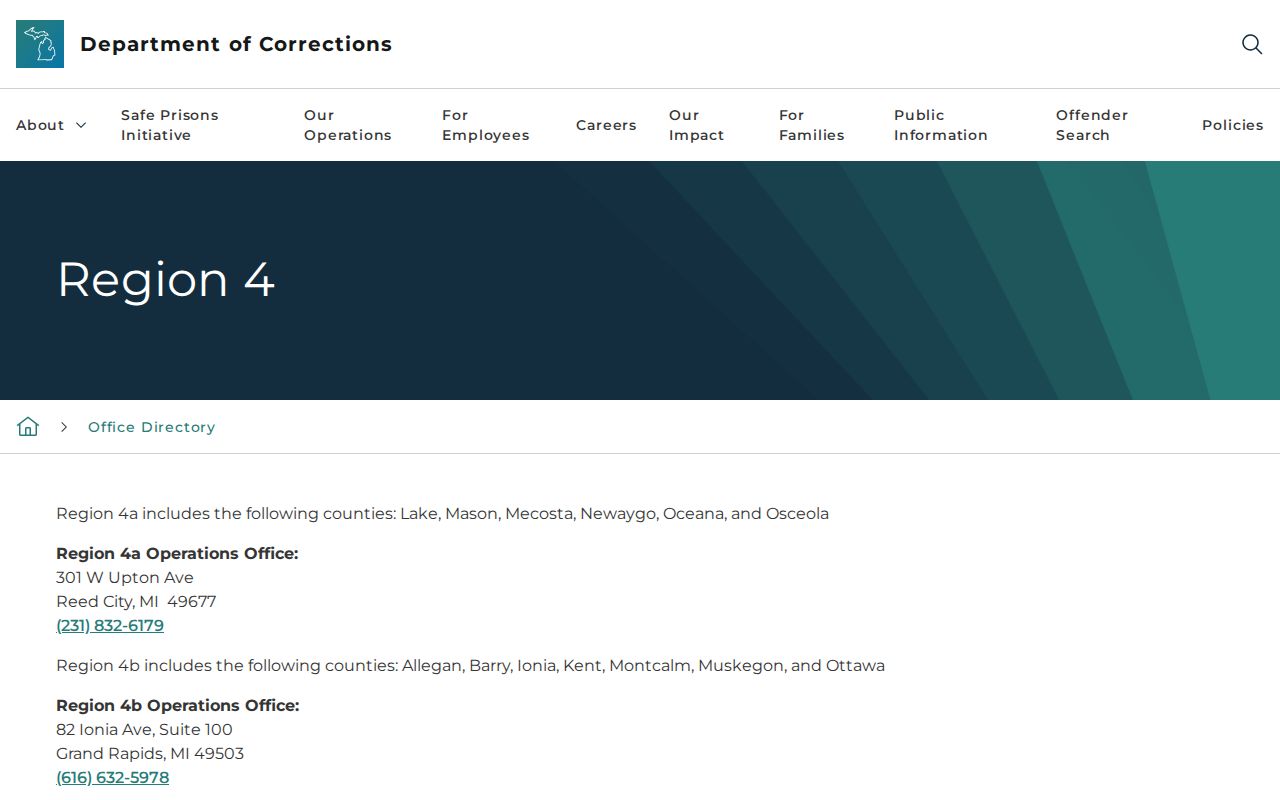
The directory connects a Mason County OTIS location to the field office that administers local supervision.
Mason County Parole Decision Records
The Michigan Parole Board makes parole decisions for eligible state prisoners. Eligibility is not a promise of release. Under MCL 791.233 and 791.234, the Board applies statutory standards, and some sentence categories have special or no parole eligibility. The conviction law, offense date, judgment, and sentence type all matter. A Mason County jail-only sentence is not decided by the Michigan Parole Board.
MDOC says the parole-consideration process commonly begins months before eligibility and includes an interview. A grant then moves through the Parole Release Unit. The research notes that at least 28 days separate a release decision from physical release. Thus, a grant does not prove the person has left prison. The later OTIS “Date Paroled” field is the public confirmation of prison release to parole.
Public hearing registration and press notices should not be portrayed as a name-by-name calendar of all routine parole interviews. Public notices chiefly cover specific statutory public proceedings. Quarterly Parole Board Decisions Reports are aggregate reports. They count grants, denials, deferrals, and reasons, but they are not an individual decisions lookup.
The official quarterly report archive illustrates that statewide aggregate channel.
An individual Mason County outcome still requires OTIS, the MDOC record, or a focused Board request.
Mason County Absconder Status
OTIS includes parole-absconder and probation-absconder search choices. An absconder label alleges that the supervised person is unavailable to MDOC. It is not a new conviction, and it is not the same as complete discharge. A county warrant, probation-violation filing, and parole absconder entry may concern related conduct, but each is a distinct record made by a different authority.
MDOC directs information about a parole absconder to local law enforcement and publishes the Absconder/Escapee Tip Line at 517-755-0855. Do not approach a person or try to enforce an order. For an OTIS error tied to supervision, MDOC says the appropriate parole or probation office is the correction route. Court-derived errors should be raised with the sentencing court.
Conditions vary by the order and case. At a high level, supervision can require reporting, approved residence or travel, compliance with court and agent directives, and completion of ordered programs. Only the actual order and assigned office can state the current terms. A suspected violation does not by itself establish revocation or a new sentence.
Note: VINELink reports custody events, not the full set of parole or probation compliance decisions.
Mason County Reentry Through Supervision
MDOC Offender Success Reentry Services directs eligible parolees and other specified supervised people to ask their parole agent about services available in their county. That is a useful Mason County route because the local agent can assess eligibility and current availability. It does not guarantee a particular program, benefit, or provider.
The first practical step is to use the supervision office shown on OTIS. The Mason County office can then point the supervised person to current MDOC channels. Family members should not assume that a statewide service description means a place is reserved locally. The agent and current program rules control.
A request for help should identify the immediate need and the supervision status without assuming that every person qualifies for the same service. The local agent can explain whether a current MDOC reentry channel applies, whether another office must act, and what documentation is required. A person released on county bond is on a different legal path and should follow the court's conditions instead. Likewise, someone fully discharged from MDOC may no longer be served through an active parole case. These distinctions keep a Mason County referral tied to the agency that still has authority.
Mason County Supervision Discharge
Physical release and discharge are separate events. “Date Paroled” marks release from prison to parole. Discharge later ends MDOC supervision on that sentence. A probation term likewise ends under the controlling order, not merely because the person is no longer at the Mason County Jail. MiCOURT may show probation events and closure, while OTIS may show current or recently discharged MDOC status.
MCL 791.208a keeps qualifying MDOC information publicly available through OTIS for three years after release from MDOC jurisdiction. Once that window passes, absence is expected. Older proof should come from the sentencing court or an appropriately scoped MDOC records request. Ask for the particular public discharge document or data point needed. A general requester should not be told to order a PENPACK, because MDOC restricts that package to recognized criminal-justice authorities for official business.
If an OTIS record remains active, read its status and location. If it says discharged, record the date and verify any important discrepancy with MDOC. If no record appears, test spelling, aliases, and MDOC number before moving to court records. “Not located” is the sound conclusion until an authoritative record establishes more.