
Mason County Release Date Types
“Projected release date” is not one official Michigan field. MDOC centers its public explanation on “Earliest Release Date” and “Maximum Discharge Date.” The earliest date is the point at which the minimum sentence permits the Michigan Parole Board to obtain jurisdiction. It does not promise parole. The maximum discharge date is the outside date on the controlling maximum sentence, subject to lawful calculations and later orders.
Mason County Jail uses a different record. A county sentence is a definite jail term carried out by the sheriff under the court’s judgment, jail-credit award, and later orders. A pretrial booking has no sentence-based release date at all. Bond can permit release while the case continues, and a hold from another agency can prevent community release even after the local basis for custody ends.
Scheduled versus actual: A scheduled date predicts a possible event. The jail out record or MDOC “Date Paroled” confirms that release occurred.
Find Mason County Projected Dates
Start with the present custodian. Mason County Jail, MDOC, BOP, and ICE use different records. Geography does not decide the system. A person convicted in Mason County can be held in an MDOC prison elsewhere in Michigan, while a jail-only sentence remains outside OTIS even though both cases began in the same local court.
- Identify the custodian and legal stage. Separate pretrial county custody, a definite jail sentence, an MDOC prison sentence, and a transfer hold.
- For Mason County Jail, call 231-843-3475 and ask whether the booking has a court-set term, jail-credit entry, bond event, or hold.
- Check the 79th District Court for misdemeanors and felony preliminary stages. Check the 51st Circuit Court for a bound-over felony judgment and sentence.
- For an MDOC prisoner, search OTIS by MDOC number when possible, then read status, location, earliest release date, and maximum discharge date together.
- Confirm a predicted date with the custodian. After release, obtain the actual jail out date or read OTIS “Date Paroled” or discharge information.
The direct OTIS search endpoint supplies the state search controls. Its successful manifest capture shows the official entry used for a Mason County case that reached MDOC jurisdiction.
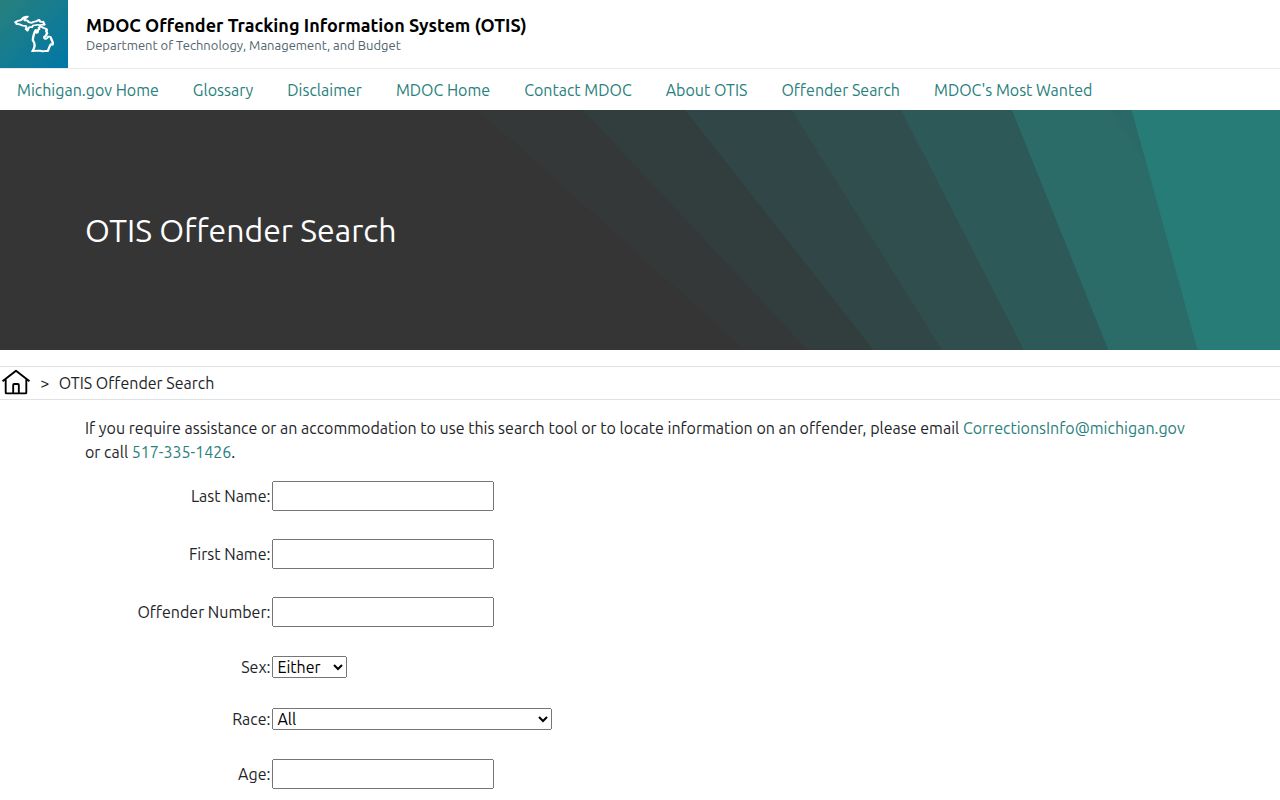
The form is not a Mason County jail roster. It searches MDOC prisoners, parolees, probationers, and qualifying recent discharges.
The Mason County released inmate search explains how the sheriff release record and local court chronology work together after someone leaves the county jail.
Note: An MDOC number gives a much cleaner match than a common name and helps prevent a wrong projected-date identification.
Mason County OTIS Date Fields
OTIS permits name and offender-number searches, along with sex, race, age, marks, scars, tattoos, and status filters. Status choices include prisoners, parolees, probationers, discharged people, parole absconders, and probation absconders. On a candidate profile, compare the MDOC number, full name and aliases, identity details, convictions, court information, and image when available. Then read status and location before using any date.
| OTIS field | Meaning for release timing |
|---|---|
| Earliest Release Date | The minimum-sentence point when the Parole Board gains jurisdiction, not a guaranteed exit date. |
| Maximum Discharge Date | The outside sentence date as lawfully calculated if parole does not produce an earlier prison release. |
| Date Paroled | Public confirmation that the person left prison for parole supervision. |
| Status and location | Shows whether the person is a prisoner, parolee, probationer, absconder, or discharged person. |
| Discharge information | Shows the end of MDOC jurisdiction, which can occur after prison release and parole. |
A parole status with a field-office location means physical release from prison into supervision, not full discharge. A prisoner status with an institution means state custody continues, even when the earliest date has passed. OTIS excludes county-jail-only cases and people more than three years beyond MDOC discharge. Older or missing records therefore need the sentencing court or an appropriately scoped MDOC records request.
Michigan Truth In Sentencing
Michigan must not be described with a generic “serve 85 percent” rule. The state’s truth-in-sentencing framework generally requires a prisoner sentenced for a qualifying offense committed on or after the relevant effective date to serve the full judicial minimum in a secure facility before parole eligibility. The offense date, conviction law, judgment, and sentence structure control. A quick percentage taken from the sentence length can therefore produce a false Mason County projected release date.
The official MDOC truth-in-sentencing explanation is the source for that distinction. The captured state page below documents why Michigan sentence timing needs the judgment and MDOC calculation, not a borrowed formula.
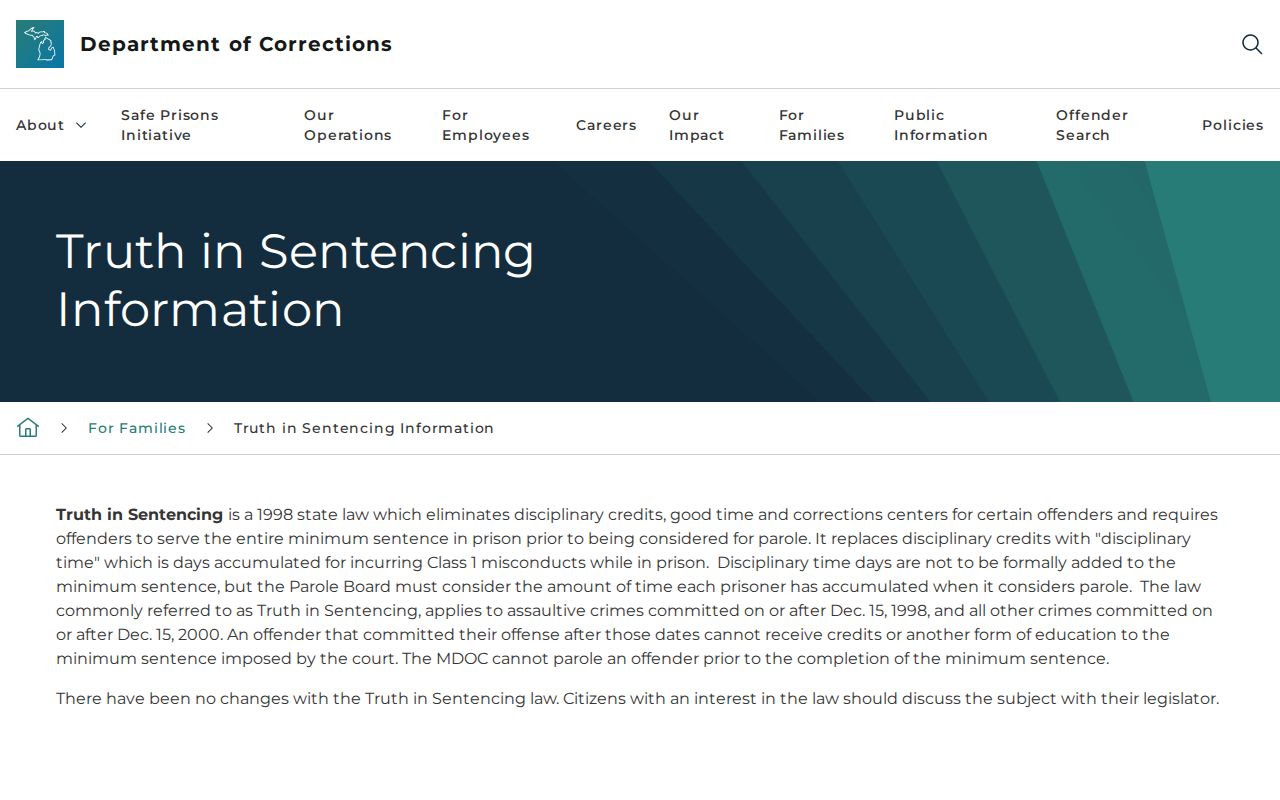
The rule addresses parole eligibility from prison. It does not set a release date for a Mason County pretrial detainee or a person serving only a county jail sentence.
Note: “Parole eligible” means the Board may act; it does not mean parole was granted or the prison exit occurred.
Mason County Sentence Credit Rules
MCL 791.233 generally bars parole until the minimum term has been served and addresses credit treatment for eligible older sentences and disciplinary-time prisoners. MCL 800.33 distinguishes good time, special good time, disciplinary credits, and disciplinary time by offense date and sentence. Modern truth-in-sentencing cases do not receive a simple reduction of the judicial minimum.
Older sentences can fall under different credit rules. Misconduct may affect credit or disciplinary consequences where the law permits. Jail credit awarded in the Judgment of Sentence can also affect the time credited toward a state sentence. These are record-based calculations. They should not be estimated from an arrest date, a news report, or the number of months announced in court without reading the signed judgment.
- Jail credit
- Time the judgment directs to be credited toward the sentence.
- Minimum sentence
- The judicial term tied to the first point of Parole Board jurisdiction.
- Maximum sentence
- The controlling outside term used in the maximum discharge calculation.
- Consecutive sentence
- A sentence that runs after another sentence rather than at the same time.
Mason County Dates Can Change
An OTIS date is a public snapshot. The Judgment of Sentence and MDOC time computation control. A later court order, corrected credit, or sentence structure can change the display. Parole decisions affect whether prison release occurs near the earliest date, while the lawful maximum remains the outside measure if parole does not occur.
| Factor | Possible effect | Best confirmation |
|---|---|---|
| Parole decision | A grant can move the case toward release; denial or later review keeps prison custody in place. | Parole Board process and later OTIS Date Paroled |
| Consecutive sentences | One term may run after another and extend the controlling dates. | Judgment and MDOC computation |
| Jail-credit correction | Added or corrected credit may alter the calculated sentence time. | Sentencing court order |
| Resentencing or amended judgment | A new lawful order can replace the prior calculation. | Official court file and MDOC |
| Disciplinary consequence | Eligible older-credit cases may be affected under the governing offense-date rules. | MDOC time computation |
| Detainer or hold | Release from one custodian can become a transfer to another authority. | Holding agency and receiving agency |
The Parole Board’s public process also has a timing gap. MDOC says parole consideration can begin months before eligibility, and a grant moves through the Parole Release Unit. At least 28 days may separate the release decision from physical release. A grant is therefore not the actual exit record. “Date Paroled” is the public confirmation after the release occurs.
Mason County Jail Date Limits
No sourced Mason County weekend-advance-release rule or local jail good-time policy was found. None should be assumed. The sheriff executes the definite jail term and the court’s credit or release orders. For a jail-only sentence, ask the sentencing court for the judgment and jail-credit entry, then ask Mason County Jail for the operational release date.
The local court level depends on the case. The 79th District Court search covers misdemeanors and felony preliminary stages. A felony bound over for final disposition proceeds to the 51st Circuit Court search. Search both when the case path is unclear. A bond order may explain pretrial release, but bond is not a dismissal. Likewise, completion of jail time does not by itself prove that probation or another sentence ended.
Use the Mason County Sheriff FOIA route when an exact out date and disposition are not available by phone. A narrow request can ask for the booking number, admission date and time, release date and time, disposition, destination or receiving agency, and case number. Asking whether the event was community release or transfer prevents a serious error.
Mason County Parole Timing
For an eligible MDOC prisoner, parole review and physical release are separate events. The official process can begin about six months before the eligibility or reconsideration point. MDOC describes an interview by secure video with one Parole Board member. A denial may set a later review under the applicable guidelines. A grant sends the case into release processing, but it does not mean the person left prison that day.
MDOC also describes at least 28 days between the release decision and physical release. During that span, the Parole Release Unit completes the next part of the process. Other lawful issues can still affect the outcome. That is why an earliest release date, an interview, and a grant should never be reported as the same Mason County release event. The later OTIS “Date Paroled” is the public field that confirms the person moved from prison into parole status.
The Michigan Parole Board makes the decision, while an assigned agent supervises the person after release. Parole means conditional release from prison with continuing MDOC legal custody. Discharge comes later and ends that jurisdiction. A Mason County jail-only sentence does not go through the Michigan Parole Board, even if the local case also includes court probation.
Confirm Mason County Release Dates
For an MDOC prisoner, compare OTIS with the sentencing court and contact MDOC when the date is critical or appears wrong. Court-derived errors should go to the sentencing court. A supervision error, such as an incorrect absconder status, should go to the supervising parole or probation office. MDOC identifies correctionsinfo@michigan.gov for inaccurate, outdated, or incomplete public OTIS information.
For a pending event, a Mason County VINELink release check can register an agency-fed alert. Treat the alert as notice to verify, not as the final record. A transfer can end Mason County custody while a person remains confined elsewhere. Federal and immigration cases also require their own custodians, since OTIS does not cover BOP or ICE detention.
Final check: Match the scheduled date to the correct person, status, court judgment, and custodian before reporting that release occurred.
Note: The actual jail out line, OTIS Date Paroled, or discharge entry is stronger than a future date viewed alone.